Minnie Manygoats
Price: $6200
Dimensions: 16.5”H x 13"W x 13"D
Edition of: 30
The idea for this sculpture came from an elderly Colorado Rancher who told me about a Navajo fence-builder named Johnny Manygoats and his wife Minnie. I knew “Manygoats” was a fairly common Navajo name (purely descriptive, it references an ancestor who possessed a lot of goats), and that Minnie was taken from English. The combination of the two had a poetic quality I liked, and when the rancher told me Johnny and Minnie eventually left to raise stock of their own, it made me want to someday do a piece that caught up with Minnie.
The primary livestock that the Navajo raise are sheep and goats; sheep for the wool, and goats for the milk and meat, (except for the angora goats). One advantage to goats is they usually bear twins, so they multiply faster than sheep. They are also more intelligent. Navajos say they like to have a few goats in every herd of sheep to keep the sheep in line.
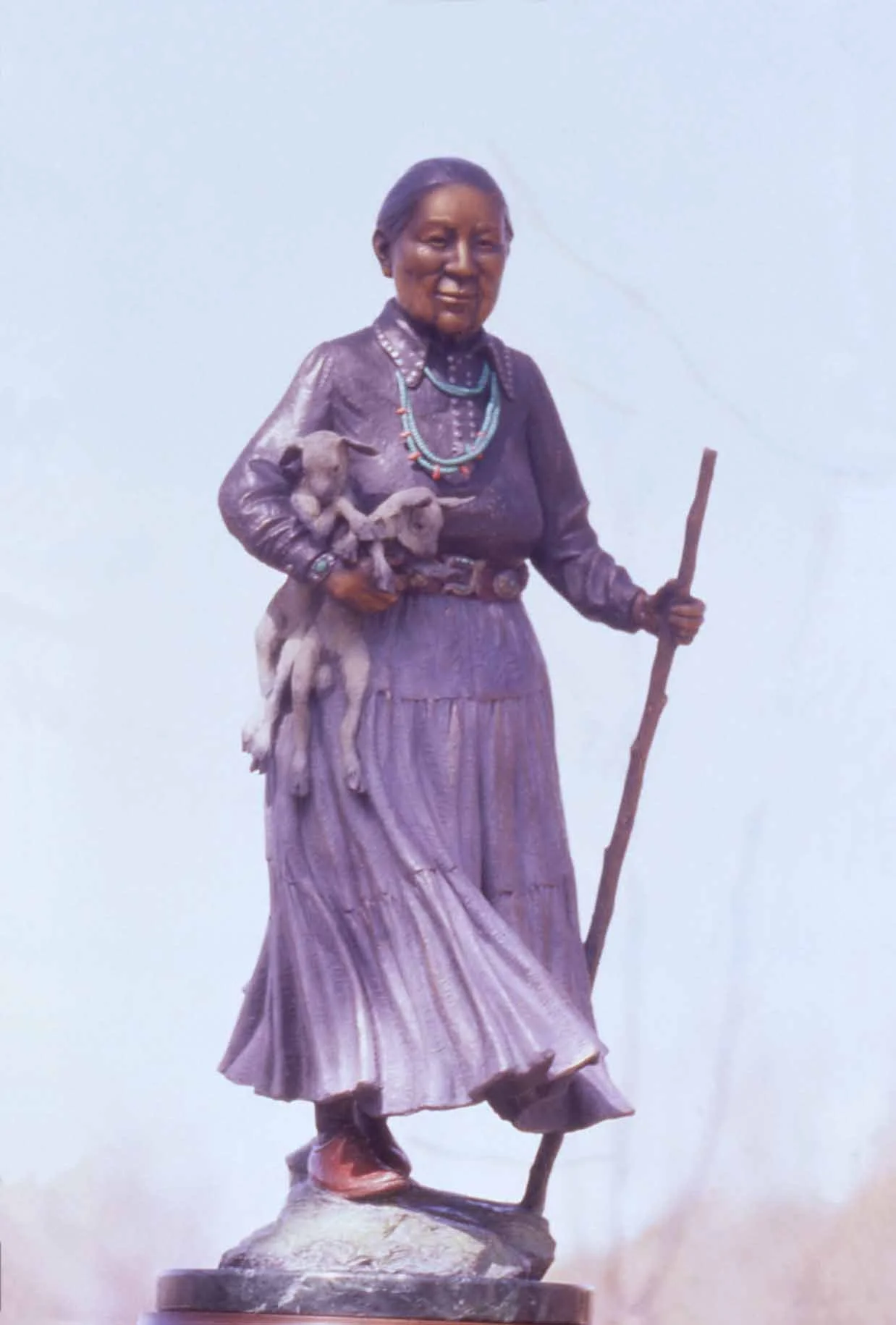
I wanted to sculpt Minnie going about a task that portrayed her living in harmony with the world around her. Walking in beauty, as the Navajo would say. When this particular image came to mind – a Navajo woman coming home with two stray kids, as young goats are called, in her arms - I liked it because it suggested an enlarged sense of family.
Minnie’s expression was important to me. I wanted her to have a subtle smile of contentment; she is someone who derives satisfaction form her work. I also find it charming the way the Navajo are practical and will incorporate innovations from other cultures into their own that make life easier or more comfortable. And so Minnie, though dressed traditionally, also sports a pair of tennis shoes.The idea for this sculpture came from an elderly Colorado Rancher who told me about a Navajo fence-builder named Johnny Manygoats and his wife Minnie. I knew “Manygoats” was a fairly common Navajo name (purely descriptive, it references an ancestor who possessed a lot of goats), and that Minnie was taken from English. The combination of the two had a poetic quality I liked, and when the rancher told me Johnny and Minnie eventually left to raise stock of their own, it made me want to someday do a piece that caught up with Minnie.